
When I’m explaining casework to people who are hearing about it for the first time, one of the first things I harp on to death is that there is a strict, bright line between what happens on the campaign side of a Congressional office and what happens on the elected side. Official resources, including staff time, can’t be used for campaign work, and casework is as official as it gets. Caseworkers help constituents regardless of how they vote, and they’re kept well away from the reelection effort.
The problem, though, is that the two really are inextricable, and they affect each other in unavoidable ways.
An election decides whether a casework team will keep their jobs in January. Casework responsiveness is a huge part of the value proposition for many candidates — or, conversely, a weak operation is an effective vulnerability that a smart challenger can exploit. Elections are the accountability mechanism for the whole of a Representative’s work, including how they manage their casework team — and they’re also a huge operational challenge for offices having to figure out how to do casework through the uncertainty of an election.
As we head into the home stretch of the 2026 midterms, casework teams across the country are already planning and preparing for transitions. Today, we’re going to talk through what happens to casework in an election year, how the burden of transition is unevenly spread across offices, and how all of that is changing my mind on the right approach to institutional support for casework.
It’s math time.
Caseworkers, if this describes you and your team, and you’re looking for resources on how to manage this process, don’t miss this week’s Casework Mirror issue for some tools and templates.
Constant conditions of casework
As we set up this extended word problem, there are a few things we can take as givens about how we know casework works:
Constituent demand is relatively constant within the same district or state: A set population of constituents, all other things being equal, will generate a relatively predictable1 amount of demand for help navigating intractable problems with the government.
Casework teams per state are fixed leading to an election: The supply of offices available to meet that demand is fixed: every constituent has one House Member who covers their district, and two Senators who cover the entire state. Civics!
Most cases take longer than 30 days to resolve: For most offices, a standard agency inquiry letter requests a response within 30 days, putting 30 days as the minimum estimable length of time that a case will take (many resolve faster, and many many resolve slower). However, we’ve established that, on the whole, cases are just taking a lot longer to resolve than ever before. A case that an office could have estimated taking 60 days in the past may stretch to 90 or 120 days as agencies are slower to respond and require more back-and-forth to reach a resolution. For the sake of our math problem, let’s say that 30% of cases take less than 30 days to resolve, 40% take between 30 and 90 days, and 30% take longer than 90 days.2
Most offices avoid handoffs to minimize disruption to constituents and duplicative work for staff: Finally, casework transitions suck. For a gold-standard handoff between two existing Congressional offices,3 the outgoing Congressional office has to get the constituent’s permission to hand off the case, prep case materials for the new office to understand what’s happening, and complete the warm handoff, connecting the constituent to their new caseworker. The Congressional office taking on that case has to establish the new case in their Constituent Relationship Management (CRM) system, get a new signed Privacy Act Release Form from the constituent, re-establish the pending inquiry with the agency, and establish the relationship with the new constituent. Taking on a case midstream is in many ways much harder than initiating a case from scratch. For a brand new casework team, it’s pure chaos.
You can see where this is all going.
It’s math time
Let’s say we have a small state where every Member of Congress in that state is from the same party, to keep things easy. We have our two Senators and two Representatives. One Senator has already announced their retirement; one House Member is also retiring, and the other lost their primary: three out of four elected Members for that state will turn over in January.
Let’s say that both Senators average opening around 100 cases per month, and each House Member averages opening around 90 — so we have 380 cases per month for the state on our demand side.
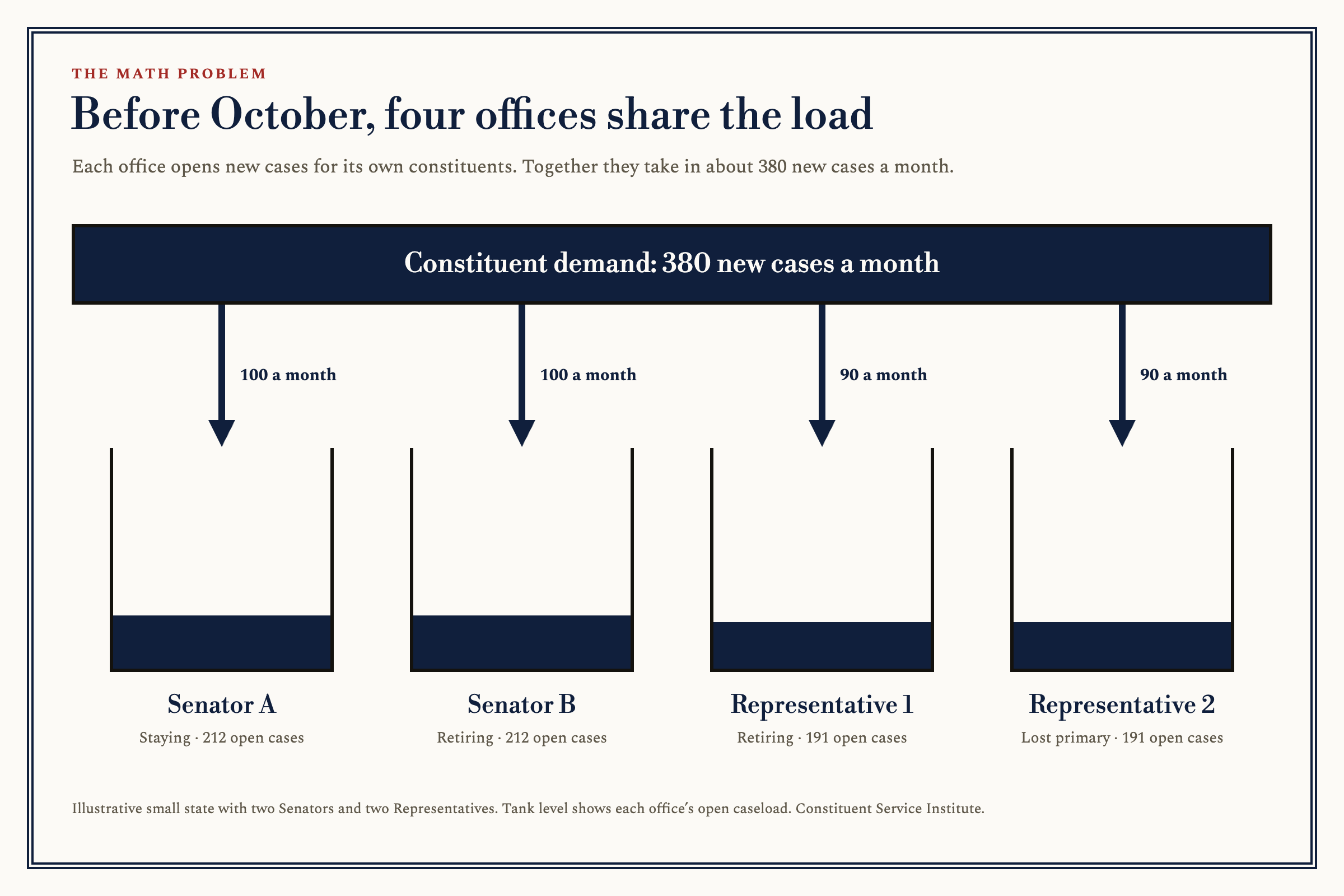
At a certain point in the fall — usually the beginning or middle of October — the outgoing offices (and offices that don’t know if they’ll be outgoing) want to stop opening new cases to minimize those transitions — knowing that they likely won’t remain in office long enough to see longer cases through to completion.
As we’ve discussed before, casework demand moves like water: it cannot be created or destroyed, but seeks an outlet wherever it can find one. Because constituent demand has to go somewhere, instead of taking the case themselves, the outgoing offices instead encourage the constituent to call the Senator who will remain in office — or take the constituent’s details and send them to the Senator’s team directly.
This means that the one remaining Senate office now has to plan and manage an increase of 280 new cases per month they will open for October, November, December, and likely at least January. They are now the de facto only office with a functioning casework team for the state on all new intakes.4
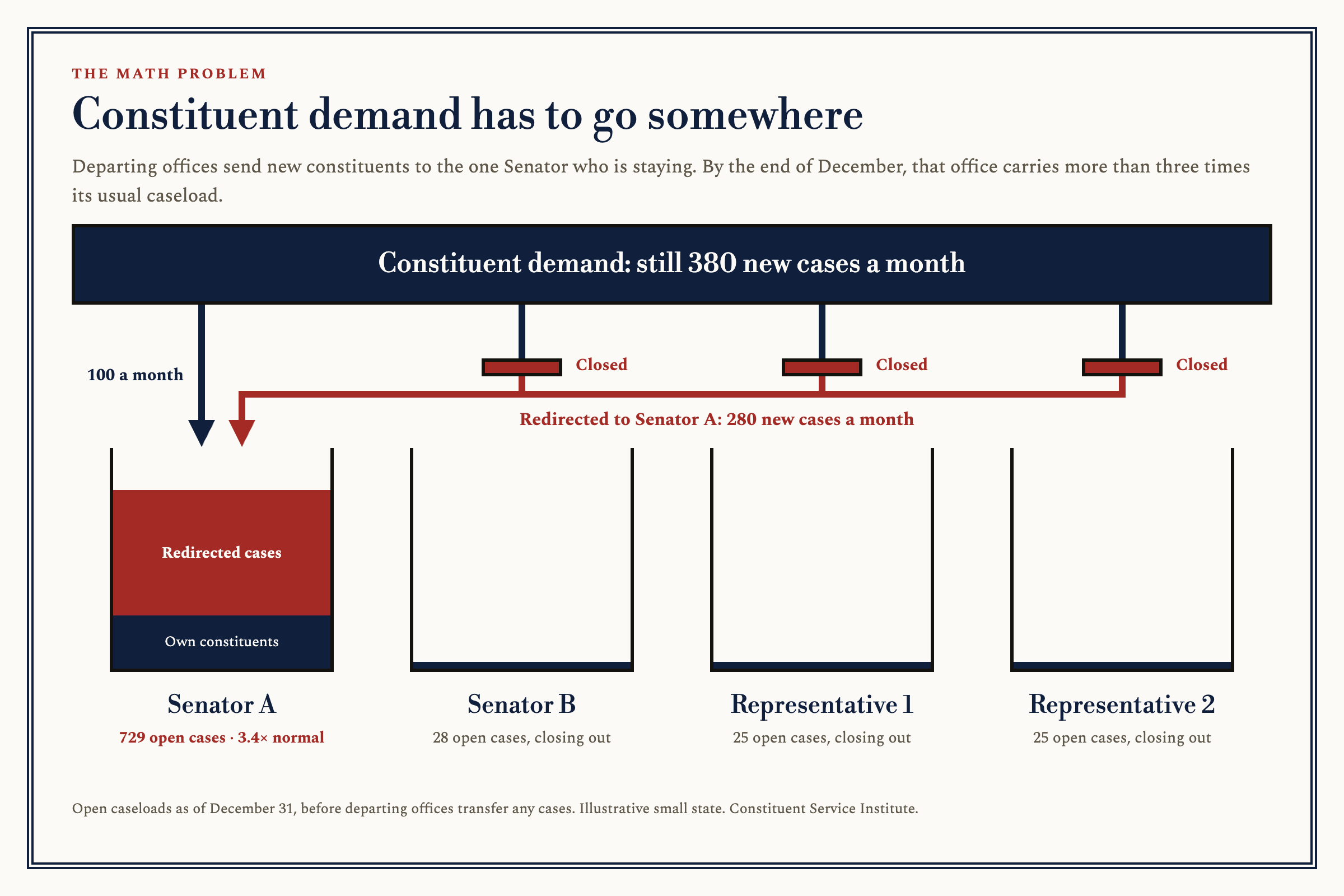
Last but not least, once the outgoing offices actually close up shop at the end of the year, the final remaining office will get a significant portion of their cases as transfers. This is its own complex set of tradeoffs: because casework data belongs personally to the Member, the Member has to decide whether they want to authorize open cases being transferred to their successors — and they have to sign a form authorizing the transfer (and paying for it). Chasing down a Member who’s just lost a primary and is trying to figure out their own next steps can fall down on the priority list in the chaos of closing an office. The incoming Member likewise has to decide if they will accept those open cases — and it’s not as simple a decision as it may seem, especially if the outgoing Member used a different CRM than the incoming Member’s team plans to use. Cases do not transfer seamlessly between CRM programs, meaning a bulk upload of incoming cases can end up an administrative and records-keeping mess of missing or corrupted data that’s more trouble than it’s worth.5 Given that complexity, let’s average it and assume about half of the cases still open transfer to the remaining Senator in December.
Here’s how our math problem breaks down month by month from September to April.
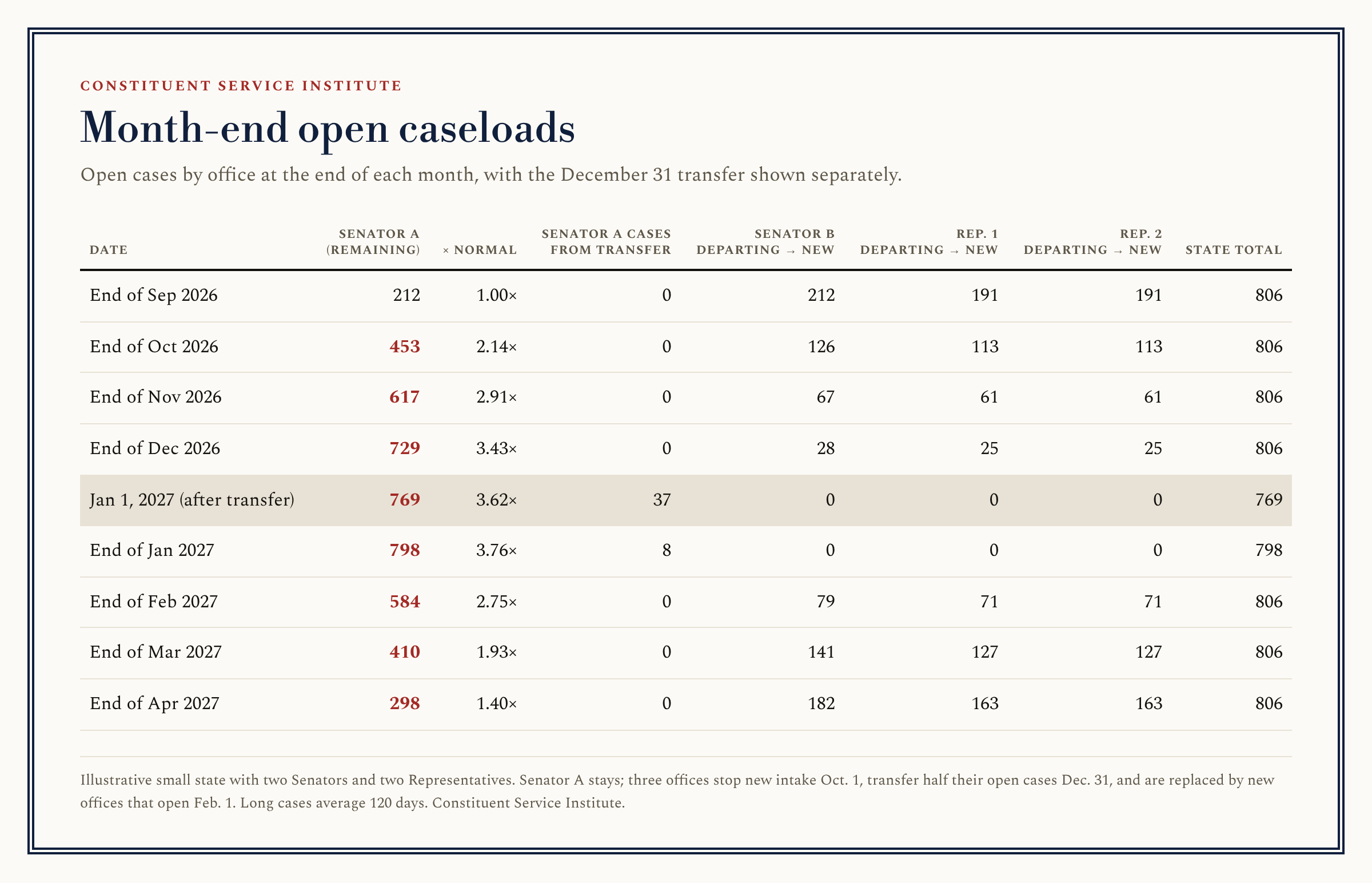
By December, the remaining Senate office has a 3x increase in their carrying caseload. By January, they hit a peak of almost 4x.
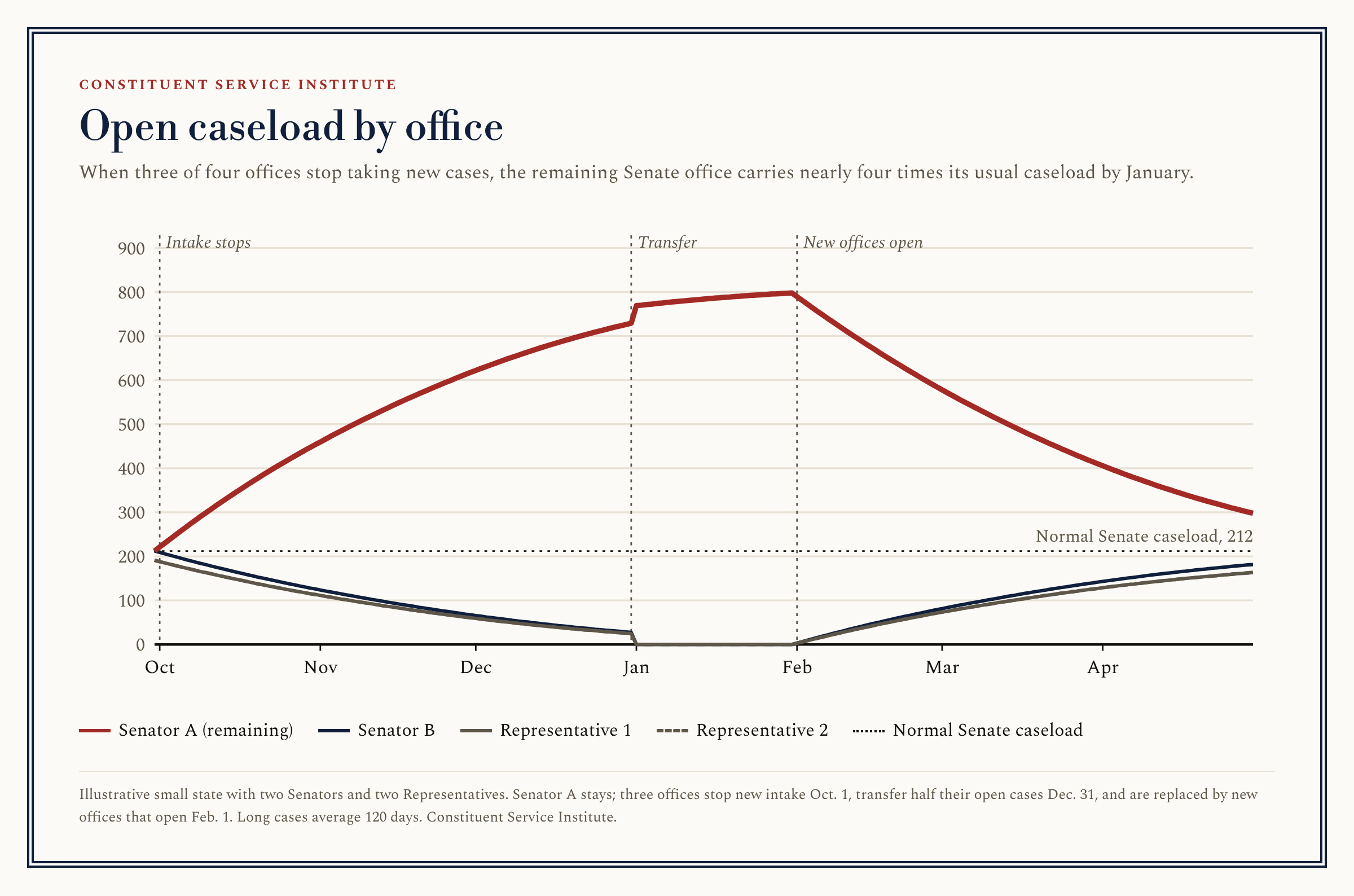
Ultimately, there are more than six months where this Senate office is handling a higher-than-normal caseload. The only other scenario where we see a Congressional office have to manage a surge in their caseload like this is a natural (or manmade) disaster. The difference is that — up-in-the-air elections aside — this is a disaster that offices can plan for.
The only other scenario where we see a Congressional office have to manage a surge in their caseload like this is a natural (or manmade) disaster. The difference is that — up-in-the-air elections aside — this is a disaster that offices can plan for.
Casework transitions are a disaster (equivalent)
This is a back-of-the-envelope estimate that deserves caveats all over the place, of course. This is the simplest possible scenario — but it describes at least one state in the 2026 election cycle, Wyoming, with New Hampshire and Iowa potentially in the same boat. Larger states are not exempt either: while Senate teams are larger in bigger states, they may be absorbing casework from larger numbers of departing House colleagues.
The scenario gets more complicated with mixed-party delegations, where offices may have different working relationships — the vast majority of caseworkers we talk with have strong working relationships with colleagues on both sides of the aisle, but still may prefer to transfer especially politically sensitive cases (e.g. gender transition, land rights, undocumented immigration, high-profile constituents, etc) to copartisans, or to close them out if no preferred transfer is possible. Even in the same party, offices may have specific preferences for transferring to casework teams that share similar approaches, further complicating the landscape for where and how this demand flows.
But while this may not describe each and every transition scenario, in my conversations with caseworkers across the country, I think the norm is in general to err on the side of trying to do a good job, under difficult circumstances — let us not forget that the outgoing caseworkers here are managing professional uncertainty and career transitions of their own.
The mechanics of these transitions underscore how collaborative casework as a practice can be, and how much time and effort constituent services staff put into making sure constituents have the best possible experience working with their teams. But it also underscores how much the burden for these transitions falls unevenly on individual offices.
None of this changes what constituents need. Someone waiting on a stalled VA claim or a lost tax refund still needs help in November, whether or not their Representative is on the ballot. When the burden of a transition falls unevenly and offices are left to improvise, some of those constituents will get slower, patchier service than they would any other time of year — and God help a state in the scenario described above if they were to experience a natural disaster that added an additional order of magnitude to their casework demand in this transition. That service lapse will arrive at exactly the moment they’re most saturated with campaign ads telling them how hard their Members of Congress are working for them. It’s an inadvertent failure, but it’s the kind that leaves people feeling alienated from the offices that are supposed to be their most direct line to the federal government.
When the burden of a transition falls unevenly and offices are left to improvise, some of those constituents will get slower, patchier service than they would any other time of year — and God help a state in the scenario described above if they were to experience a natural disaster that added an additional order of magnitude to their casework demand in this transition. That service lapse will arrive at exactly the moment they’re most saturated with campaign ads telling them how hard their Members of Congress are working for them.
I’ve changed my mind on what caseworkers and constituents need in transitions
I’ve been actively working in the “Fix Congress” world to support institutional reforms to strengthen the first branch for the last five years — and have been grateful to see casework take a larger role in that work. Transitions have been a consistent area of focus, with some wins focusing around helping new offices hire district staff earlier and trying to drill down into why some Members of Congress do not opt to transfer open cases.
To be honest, this series of conversations with casework teams in transition, and the thought exercises of working on the math here, have changed my mind on a few things. And as we work to launch the Constituent Service Institute, I think that’s exactly what we want to happen! Talk to caseworkers, learn things, adjust — and most importantly, share what we’re learning and how we’re adapting.
So with that in mind, here are my four big takeaways — two things that would help smooth these transitions, and two ways this makes me think differently about institutional support for casework:
We’ve been focused on the wrong handoff
When the Fix Congress world (myself very much included) has focused on casework transitions in the past, we’ve usually pictured one model: the outgoing Member works on all cases right up until the moment they have to turn in their keys, and authorizes a digital transfer of case files to their successor. Most of the time and political capital expended on casework transitions has focused on whether or not that authorization happens. This is a real problem — I’ve lived a version of this myself. I joined a House office two years after the Member took office, with no transfer from his predecessor, and we were still getting calls from constituents asking what happened to their case.
But after talking to caseworkers about how transitions actually play out, I think the successor transfer is a much smaller piece of the picture than we’ve assumed. By the time anyone is chasing down a transfer form, outgoing offices have often spent months winding down. They stop intake in the fall, steer new constituents to the office that’s staying, and hand off cases to a copartisan colleague in the other chamber where they have one. Experienced teams put a lot of work into those handoffs precisely so they don’t have to count on a CRM transfer at the end.6 The real transition is a months-long redistribution of demand across a whole delegation, not a single handoff in January.
It’s still important to figure out how we can encourage Members to see their caseload as something they are stewarding, rather than owning, and support and encourage authorizing those transitions. But I think it’s a lot less important and a lot less impactful than I previously thought, and other interventions would be more effective to smooth out transitions.
Casework is a data operation, and casework management requires specific tools
I was recently talking with a casework director who is living something close to this scenario. She’s been through several transitions, so she knew this would be a challenge. To figure out the scale of what her office would face, she called every other office in her delegation and asked about their open caseloads, how many cases each caseworker carried, and when they planned to stop opening new cases. It helped that she has good relationships with her colleagues, and that those offices track their cases well. Based on what she learned, she asked her office for at least two more full-time caseworkers.
That she had to do all of this by phone on her own initiative says a lot about how the burden of casework visibility, planning, and management rests on individual offices. Right now, the tools for that kind of planning don’t really exist. The CRMs offices use are built to manage individual cases, not to project what a caseload will look like three months out. (Caseworkers, if you’d like to play with a modeling tool, check out our latest Mirror issue!) This is honestly an area where I’d love to see more innovation from the CRM providers who serve the House and Senate, or at the very least, some leeway and encouragement for offices to experiment with LLM tools on deidentified casework data to model and plan. Whether it lives in the CRMs or in a casework data aggregation system like CaseCompass, caseload modeling would help offices decide where to put headcount when they can see a transition coming.
A quick helpful fix for new offices would also be a clarification from House and Senate Rules, CAO, and SAA on whether CRM providers would be allowed to share top-line casework numbers, not data, from predecessor offices — for a new office trying to figure out where to assign headcount, having even that much information (total average caseload, yearly caseload, and rough percentages for case duration) would be enough to create a model like the one above.
Transitions are a use case to test disaster surge support
So what are offices supposed to do as part of that planning process? This is actually where two separate areas of focus for modernizing casework may turn out to be closely related.
As we’ve said, the closest thing offices face to this kind of spike is a disaster, when a hurricane or wildfire sends a wave of constituents to a casework team all at once. The difference is that offices can see this one coming months ahead. For this cycle, it’s already too late. Hiring and training new caseworkers takes months, and the surge is starting now. But in the future, that predictability may make transitions the right use case for exploring surge capacity for casework.
As with other elements of modernization impacting casework, there are multiple competing proposals for how to accomplish surge capacity for disasters — including establishing a flex casework corps like the Clerk staff who take over operations when a Member leaves office unexpectedly, a fellowship program, or authorizing Member-to-Member staff details.
In the near term for this type of transition as well as disaster response, I like the idea of Member-to-Member details, letting caseworkers from a departing office be detailed to the office absorbing its casework for a set period of time. Those caseworkers already know the agencies, the open cases, and often the constituents themselves. A detail would let offices balance the load across a delegation (even between chambers) and give constituents some continuity instead of starting over with someone new. It would also give outgoing caseworkers some additional runway to find their next roles.
But in the long term, casework and casework capacity to adapt to rising caseloads must be part of ongoing conversations about overall Congressional staff sizes. Caseloads are rising everywhere as agencies get slower to respond. In the long term, we need to look at the resources available for constituent services and find additional ones, not just better ways to share what’s already there.
No one has cross-chamber casework visibility
Finally, the way this example demonstrated how casework can flow between chambers was an “aha!” moment for me, because it’s just absolutely not part of a lot of our common mental models for how casework works. This whole scenario only becomes visible when you look across both chambers at once — which absolutely no one currently has the authority or prerogative to do.
If you’ve followed my work for a while, you know that the centerpiece keystone recommendation we’ve pushed above all else is the creation of a Casework Liaison Office (CLO) — one central body with responsibility for supporting constituent service staff and operations, acting as a long-term institutional product manager for CaseCompass, helping casework teams make sense of the resources available to them, advocating with agency liaisons, liaising with the CRM community, etc. The initial vision for this office was bicameral for just this reason: caseworkers in both chambers manage the same cases, and there should be effective visibility and coordination between them.
However, over the last few years, modernization has moved much faster in the House than the Senate — so it started to seem more effective to press solely for a House CLO, under the Chief Administrative Officer, with more precedent, more infrastructure, and more demonstrated appetite for this type of work. This was a reminder to me of why the bicameral office is important in the first place: a House-only office could see the departing House offices winding down, but it would miss the Senate office absorbing their constituents, which is where the strain actually lands. That cross-chamber view is worth fighting for, even if it’s harder to get.
Modernization is always about this type of tradeoff: is an interim step a foothold toward the thing we actually need, or does it quietly become the ceiling? A House-only Casework Liaison Office would be real progress, and I’d still celebrate it. But this cycle is a good reminder to keep checking our modernization strategy against how casework actually works on the ground.
Wildly variable between districts; relatively constant between them; the exception obviously being disasters and surge events like government shutdowns
For the record, I’ve tested this against known caseloads and found it to give me a pretty accurate estimate of an office’s carrying rate! Caseworkers, check out this week’s Casework Mirror for a plug-and-play version of this formula.
At least, for offices that want to do this well and put time and effort into it — which is a lot of them!
I hear you quibbling and you’re right: some constituents may just not like that Senate office and won’t open a case, even if referred. But especially for a single-party state, many will.
Especially considering that each office has different practices and conventions for casework note-keeping.
And the fact that the transfer is such a nightmare is its own issue.
